



How to Find Your First SaaS Customers?
Finding your first customers is the most critical and often the most discouraging step when launching a SaaS…...
Read the article
Our Paris-based product design agency designs the user experience and interfaces of your web applications, business software and SaaS products: user research, tested prototypes, UI design and a design system ready for development. A senior team of experts, from the first workshop to production.
Three questions to prepare a useful conversation.
Question 1/3
They trusted us to design their digital products

For a live product: analysis of journeys, usage data and user feedback, then an action plan ranked by value and effort. You know what to fix first.
From the first user interview to the design system: journeys, tested prototype and interfaces ready to build, with our developers or yours.
A senior designer joins your product team a few days a week to keep pace with sprints, evolve components and test each new feature.
What we design every day
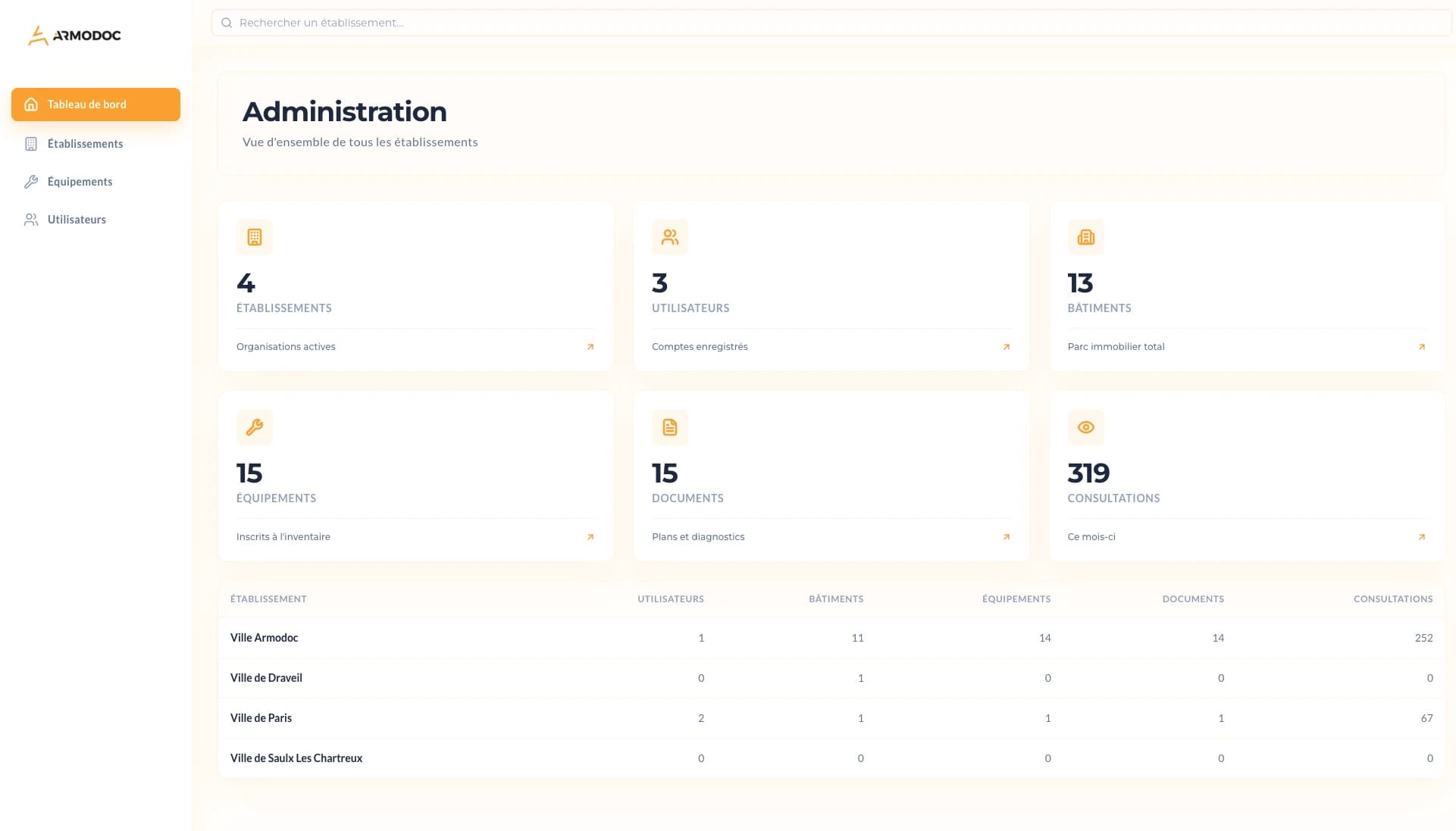
For Armodoc, the starting point was concrete: technicians worked on site without finding the technical documents they needed. Immersion in their daily work steered the design towards access by QR code and NFC tag, a simple mobile solution, then towards a citizen communication module for local authorities.
The founder sums up the result: “You delivered a product that is beyond what I expected. It is a finished product, not a small mockup.” The approach matters more than the timeline: start from real usage and the expectations of field teams, test early, then design the screens that matter. We apply this user-centred approach on every mission, with a solution adapted to each context. To validate a concept on a short scope, our MVP agency uses the same approach.
E-commerce platform & telecom services
Creation of a modern e-commerce platform unifying all group services with an optimized buying experience.
+35%
Conversion rate
+22%
Average cart value
Multi-affiliate product comparator with advanced search
Multi-merchant product comparison platform with full affiliate management. From data aggregation to monetization, a solution built to scale.
4
Affiliate Networks
10,000+
Products Aggregated
Brand-creator matching platform for content marketing
Brand-creator matching platform with intelligent matching and real-time performance analytics.
+45%
Campaign engagement
x3
Active creators
Six skills, combining designers and developers, to move from an idea or an existing product to a clear user experience that is tested and ready to build, with end-to-end support.
Team workshops, user interviews, an audit of what exists, analysis of usage data and customer feedback: this research and analysis work clarifies the problem, the targets, expectations and stakes of the project. If the market itself still needs validating, our market research agency takes over.
We structure navigation, content and the key steps of each journey: sign-up, ordering, managing a file, dashboard. The goal is to optimise the most frequent path, not to add screens: the best solution is often the simplest. Error, refusal and interruption cases are designed in this phase, not discovered during development.
Wireframes set the structure of each screen; interactive prototyping simulates the full journey. The level of detail depends on what needs testing: a structure, wording, a sequence or a strategic decision. With a prototype, the project is discussed on concrete ground and each idea finds its place, or not, before code.
Representative users perform real tasks on the prototype without being guided. We record successes, hesitations and errors, then fix and test again. Every piece of feedback becomes a decision: keep, change or drop. Tests also gauge likely adoption before launch: an essential, often skipped step.
Typography, colours, iconography and visual identity give the product a unique experience consistent with your brand and marketing. UI design also covers mobile ergonomics, contrast and accessibility, so the interface stays readable for every audience, with the same standard of quality on every screen.
We set up a design system shared with developers: components, variants, states and usage rules. It becomes a common resource for the work of the following months. Our web development agency can then build the screens; otherwise your tech team receives everything needed for integration, with a review of each developed screen and help on edge cases.
Every project starts from a clear question: which journey to improve, for which users, with what expected impact and which measure of success.
Risky assumptions go through a prototype tested with your audience before development, not through internal approval.
Designers and developers work together in the same team: every interface accounts for technical constraints, budget and integration into your product, with care for every detail.
Components, states, usage rules and source files belong to you, with support after delivery. A training session helps your team take them over autonomously.
Goals, user needs and expectations, business and technical constraints, expected value
Interviews, usage observation, data and competitor analysis
Information architecture, wireframes and interactive prototype
Real scenarios, analysed feedback, iterations on each friction point
Final interfaces, documented components, integration support and impact measurement
“Thank you so much for everything, your work was incredible. We went through 1000 hurdles, and you never gave up. You were patient, organized, available, and you transformed the project into something really solid! Without you, Upcreators wouldn't exist.”

Sofiane
CEO at UpCreators
“Great collaboration experience. Lucien demonstrated excellent technical skills, organization and listening. The project progressed efficiently under great conditions with smooth communication. Reliable, involved and full of initiative. I recommend.”

Janine
Co-founder at Astérisque
“Excellent DEV. Complex Back and Front mission handled brilliantly. Real technical expertise serving our needs.”

Fabrice
Project Manager at Celeste
Product design is the design of a digital product from real usage: understanding the user, structuring journeys, drawing interfaces, testing them and then supporting their development. It brings together UX design (the lived experience, usability, comprehension) and UI design (visual hierarchy, components, consistency with the brand), serving a measurable business goal and the value your customers perceive.
A product design agency therefore does not sell a gallery of screens. Its role, between advice and build, is to reduce risk before code: checking that a journey meets a need, that it is understood the first time and that the technical team can actually build it. An interface that ignores user expectations costs more to fix after launch than to test before.
Our design process adapts to each project and its problem: creating an application, redesigning business software, improving a SaaS journey, a sales funnel or a website that converts poorly. For many SMEs, it is also a key step in transforming the organisation: a well-designed internal tool is a tool people adopt. The signals that justify a mission are often similar, whatever the software or sector:
A UX/UI designer or UX consultant designs the experience and interface of a screen or journey. A product designer goes further: they take part in priority trade-offs, link each choice to the product vision and strategy, then track the impact after release. At PeakLab, they work with our product management agency and our developers, which avoids back-and-forth between a design agency and a separate technical team.
Structure goals, users and priority journeys in a document you can share.
Start the generatorAutomationSpot the manual tasks your product could simplify for your users.
Start the diagnosticNo-codeCheck whether your current no-code tool lets you recover your data and access.
Run the diagnosticFinding your first customers is the most critical and often the most discouraging step when launching a SaaS…...
Read the article
Can't find your question?
Ask Lucien, PeakLab's CEO, directly during a free discovery call.
It designs the experience and interfaces of a digital product: user research, journeys, wireframes, prototype, testing, UI design and design system. Its goal is a product people use and understand, not just a nice render.
UX design covers the lived experience: needs, journeys, comprehension. UI design covers the interface: visual hierarchy, components, content. Product design combines both and ties them to product goals and to measurement after delivery.
No, start with the question to settle. Customer feedback, usage data or existing tests are sometimes enough. New research is justified when uncertainty is high or data no longer reflects current usage.
There is no universal number. A few users per profile are often enough to spot the main problems in a journey; measuring how often they occur requires other methods, such as usage data analysis.
Each problem is linked to a screen, a scenario, a source and a possible impact. The audit separates finding from recommendation, then ranks actions by value and effort, with a plan to verify them.
No. Depending on scope: research synthesis, journeys, wireframes, prototype, mockups, components, states and responsive rules. We can also build the product with our engineering team.
Both, as soon as there is a journey that matters: a website that must generate quote requests, a customer area, a web application or a SaaS. A purely editorial brochure site is better suited to a traditional web agency.
When several screens or products repeat the same components, or the team loses time between design and code. A useful design system documents components, states, accessibility and contribution rules.
Yes: contrast, keyboard navigation, focus, labels and error messages are considered from the design stage. Compliance is then checked on the developed product, with its real content.
The measure is chosen before the solution: task success, drop-off, activation, support requests. After delivery, we compare against the starting point while accounting for other changes.
Yes, they are our main clients, along with a few mid-sized companies. A startup often needs to validate a first journey; an SME, to modernise business software its teams use every day.
Yes. Our head office is in Paris, at 60 rue François Ier, and we support companies across France remotely: video workshops, shared prototypes and remote user testing.
It depends on the number of journeys, the profiles to test, the level of detail and what already exists. The written proposal separates scoping, research, design, testing, UI and development support.
Consent, cancellation, deletion and refusal are tested with the same care as sign-up. An option must never hide a consequence or make leaving artificially difficult.
Can't find your question?
Ask Lucien, PeakLab's CEO, directly during a free discovery call.
A Paris-based product design and development agency, PeakLab supports startups, SMEs and larger companies across France, remotely, with designers and developers from scoping to launch. Describe your users, the journey that is stuck, your need and the impact you are after: a free 30-minute first call to know which research or prototype to start with.

Lucien ArbieuCEO and co-founder of PeakLab
Copyright © PeakLab 2026. All rights reserved.