





How to Find Your First SaaS Customers?
Finding your first customers is the most critical and often the most discouraging step when launching a SaaS…...
Read the article
Our product management agency, based in Paris, helps founders, startups and SMEs design a digital product that creates value: user discovery, product vision and strategy, a prioritized roadmap, delivery management and business impact measurement. Your team keeps control of the trade-offs.
Three questions to prepare a useful conversation.
Question 1/3
They trusted us to manage their digital products

For a new offer or a new product: user interviews, market analysis, workshops, prototyping and tests before committing to development. You leave with a clear scope, adapted to your specific need, and validated assumptions.
A senior Product Manager joins your team a few days a week: prioritization, backlog, coordination with tech and KPI tracking. Ideal while you hire, or for a growing SaaS or software product.
To structure the product function: organization, rituals, OKRs, hiring your first PMs and coaching your Product Owners, until the in-house team is autonomous.
What we manage every day
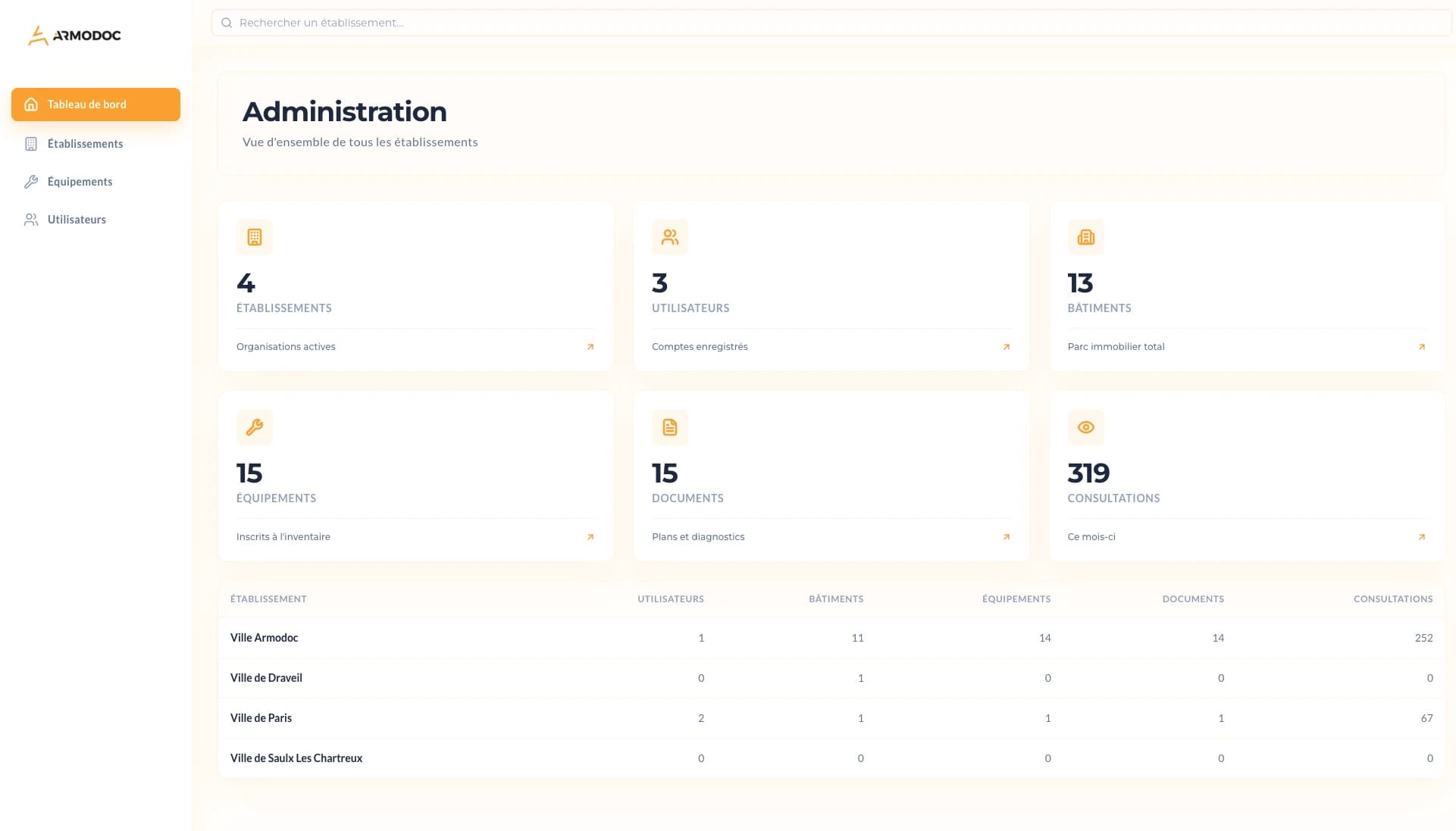
For Armodoc, PeakLab started by challenging the founder's initial vision. Field immersion revealed the real problem: technicians on site who could not find technical documents. Priority went to access through QR codes and NFC tags, a simple solution to a specific field problem, then the vision expanded to a citizen communication module for local authorities.
A first version was delivered in one month for this scope; after the product presentation, the founder secured a meeting with a town hall. This timeline describes this project, not a standard. To test a concept on a short scope, our MVP agency takes over.
Centralizing and AI-analyzing insurance contracts
Centralizing and AI-analyzing non-standardized insurance contracts to make coverage understandable for policyholders.
3 months
Full-time interim CTO
SaaS
Platform ready to launch
Brand-creator matching platform for content marketing
Brand-creator matching platform with intelligent matching and real-time performance analytics.
+45%
Campaign engagement
x3
Active creators
Solar platform & administrative automation
Platform redesign to automate administrative procedures and accelerate photovoltaic project management.
-60%
Administrative time
+38%
Revenue generated
Every engagement produces concrete deliverables, shared with your team and reusable after we leave.
We review your goals, users, usage data, internal processes and team organization, taking your specific constraints into account. The assessment says what is blocking and where to start; a market study completes it when the segment is still unclear.
Interviews, observing usage on desktop and mobile, customer support and data help separate what users say from what they do. Our product design agency turns the selected leads into prototypes to test. We can also audit the most used screens.
We connect the product vision to business goals, together with marketing, then build a prioritization grid and an outcome-driven plan to align teams, reviewed every cycle. Each initiative has a measurable goal and an expected impact, not just a deliverable.
User stories, acceptance criteria, sprint planning and sprint review: the Product Manager prepares the development team's work, with our engineers or yours, answers their questions and makes sure every release meets the expected quality.
We choose the useful metrics (activation, retention, feature usage), check the data tracking and report the results to you after each release.
Processes, rituals, tools and documentation are set up to last. We train and support your Product Owners, then help define the profile and job description if you are hiring.
Assumptions, choices and exclusions are written down in the tools your team uses, so everyone knows why one feature comes before another.
A weekly check-in, a demo every sprint and a clear goal at each step, shared with the whole team.
The founder or business sponsor keeps the vision and the budget. We prepare the options, the evidence and their consequences.
Backlog, rituals, decision log and metrics stay with you, ready for a hire or for bringing the role in-house.
Goals, user expectations, market, constraints and people involved
Interviews, usage data, prototypes and assumption tests
Initiatives ranked by expected value, effort and risk
Ready backlog, sprints, acceptance testing and release
Tracked KPIs, measured impact, user feedback and updated priorities
“We're going to talk about AI, development, digitalization, but I think we shouldn't forget the human aspect and that's what I found with PeakLab. This proximity, this human support. I needed advice, not just an executor.”

Victor
CEO at ODD Pharma
“Thank you so much for everything, your work was incredible. We went through 1000 hurdles, and you never gave up. You were patient, organized, available, and you transformed the project into something really solid! Without you, Upcreators wouldn't exist.”

Sofiane
CEO at UpCreators
“Great collaboration experience. Lucien demonstrated excellent technical skills, organization and listening. The project progressed efficiently under great conditions with smooth communication. Reliable, involved and full of initiative. I recommend.”

Janine
Co-founder at Astérisque
Product management means deciding what to build, for whom and why, then checking that what ships really changes something for users and for the business. It covers the whole life cycle of a digital product, software or SaaS: market understanding, design, development, launch and continuous improvement. It is often where an SME's digital transformation starts.
Agency, consulting firm or product studio? A product management consulting firm works mostly on organization and strategy; a product studio designs and builds. Our agency does both: advice, hands-on management and, when needed, development by our engineers. Thanks to that combination, a decision doesn't stop at a slide deck.
The Product Manager connects customers, business stakeholders, the designer and the developers. In a startup, the founder often holds this role on top of everything else; in an SME or a large company, it falls to a management team that is already stretched. Working with a product management agency gives you this leadership without waiting for a hire, with a proven method.
When this role is missing, the signs look alike:
The Product Manager owns the "why" and the "what": vision, market, users and priority trade-offs. The Product Owner translates those choices for the development team: backlog, user stories and acceptance criteria. In a small company, one person often does both; we help you split these responsibilities clearly for your specific context.
Structure your product's goals, users and priorities in a document you can share.
Open the generatorAutomationSpot the manual tasks your product could automate for your customers.
Start the assessmentNo-codeCheck whether your current no-code tool lets you recover your data and access.
Run the assessmentFinding your first customers is the most critical and often the most discouraging step when launching a SaaS…...
Read the article
Can't find your question?
Ask Lucien, PeakLab's CEO, directly during a free discovery call.
It takes on all or part of managing a digital product: discovery, strategy, roadmap, backlog, delivery coordination and measurement. It can work directly with the founder or inside an existing team.
The Product Manager owns the vision, strategy and trade-offs. The Product Owner manages the backlog close to the development team. The project manager mainly runs the schedule, budget and coordination. In a small company, one person often covers several roles.
Hiring makes sense for a permanent role on a core product. An agency fits when you need to start quickly, cover a transition, launch a new offer or set up practices the team will take over. We often help define the profile to hire.
It is the work done before building: checking that a problem exists, that it is worth solving and that the planned solution addresses it. It relies on interviews, usage data and prototypes tested with users.
By making the criteria explicit. Each initiative is tied to a measurable goal, then assessed on expected value, effort and uncertainty, with a grid such as RICE. The blocker is rarely the tool; more often it is goals that are not shared.
A KPI measures performance continuously: activation, retention, conversion. An OKR sets an intention to progress over a period, with quantified key results. KPIs describe the situation; OKRs say what the team wants to move.
Yes, they make up a large share of our work. We help SaaS founders validate their market, prioritize features and track activation and retention. See also our SaaS agency.
Yes. PeakLab is also a development agency: the same contact can manage the product and coordinate our developers, or work with your current tech team.
Yes, as soon as the website carries a journey that matters to the business: sign-up, quote request, purchase or customer area. The method is the same: understand usage, prioritize, ship, measure.
Look at its case studies, its ability to talk business rather than method, the clarity of its proposal and how it prepares the handover. A first conversation about a real topic on your roadmap often says more than a presentation.
Your team's tools first: Notion, Jira, Linear, Figma, Miro and product analytics tools. We don't impose a tool; we adapt the method.
Yes. Our head office is in Paris, at 60 rue François Ier, and we support companies across France remotely, by video call and in your shared tools.
It depends on the format (focused engagement, part-time, coaching), the cadence and the number of teams. The written proposal details the scope, the deliverables and what remains on your side.
We start from a baseline, then track the chosen KPIs before and after the launch. We only suggest an A/B test when traffic allows it; otherwise, we combine usage data and qualitative feedback.
Can't find your question?
Ask Lucien, PeakLab's CEO, directly during a free discovery call.
A product and development agency based in Paris, PeakLab supports startups, SMEs and large companies across France, remotely, with a team of product managers, designers and engineers. A free 30-minute video call with our experts to understand your product and your challenges.

Lucien ArbieuCEO and co-founder of PeakLab
Copyright © PeakLab 2026. All rights reserved.